Schedule: Mon - Fri 11 am - 6 pm | Sat - Sun closed
Tickets: Free admission
E-mail:
Location: Gagosian Paris
Address: 4 Rue de Ponthieu
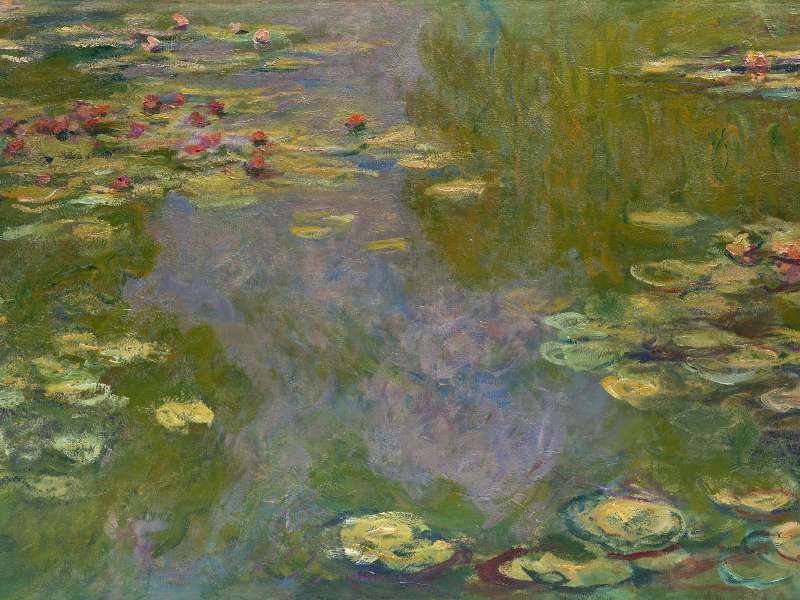
For Jennifer Guidi, landscape is not something to be faithfully represented, but a mental space where experience, memory, and contemplation merge. Over the years, the American artist, a leading figure in contemporary abstraction, has developed an instantly recognizable language made of textured surfaces, luminous colors, and thousands of tiny marks that transform the canvas into an almost meditative space. With Waterfall, the new exhibition at the Gagosian in Paris, this research focuses on the theme of water as a natural and symbolic force. The new works take shape from real places visited and imagined landscapes. Beaches, mountains, oceans, and waterfalls are not depicted realistically, but are reduced to their essential structures until they become fields of energy crossed by light. At the center of many compositions, a sun or moon illuminates the scene, transforming the landscape into a vision suspended between observation of nature and the interior dimension. Guidi's painting is born from a process as rigorous as it is intuitive. Mixing sand and paint, the artist constructs dense surfaces upon which he intervenes with thousands of small incisions and brushstrokes. The result distantly recalls pointillism, but reinterprets it through a material that gives the paintings a strong physical presence. The pinks, oranges, purples, and yellows of the earth and sky intertwine with the blues and greens of the water in gradations that convey the ever-changing light and natural elements. Although moving within the realm of abstraction, Guidi maintains a direct relationship with the experience of landscape. His works do not so much invite us to recognize a specific place as to rediscover a shared sensation: a walk on the beach, a sunset, the roar of a waterfall, or the perception of one's own smallness in the face of nature. Waterfall thus confirms a research that uses painting as a perceptual experience, transforming the landscape into a space of contemplation rather than representation.
The Musée d’Orsay explores Édouard Vuillard’s long relationship with theatre, from the 1890s to the late 1930s. Cabarets, avant-garde stages, actors and set designs enter the work of one of the leading figures of the Nabis. The first exhibition devoted to the artist in France for almost twenty-five years.
A major exhibition dedicated to Gustave Fayet, collector, painter, and patron who helped establish artists such as Gauguin, Cézanne, and Redon. A journey to discover a key figure, yet one who has remained in the shadows for too long, in the birth of modern art.
The exhibition explores Paul Cézanne's extraordinary artistic legacy, tracing how his work shaped more than a century of modern and contemporary art. A journey through the making of the "Cézanne myth," seen through the eyes of the artists who followed in his footsteps.
More than 300 photographs trace nearly two centuries of the world's most famous museum. From masterpieces to hidden spaces, the exhibition reveals how the Louvre became one of history's most photographed and reimagined cultural landmarks.