From Bob Dylan to Jimi Hendrix, from Elton John to Led Zeppelin, they all graced the illustrious illustrated doorway of Earl’s Court at the edge of Chelsea.
住所: 263-267 Old Brompton Rd, Earl's Court, London SW5 9JA
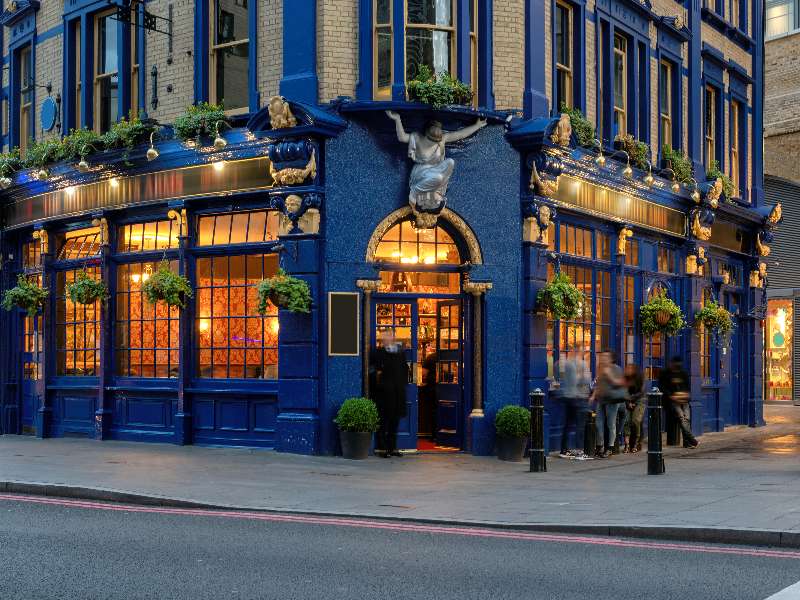
When Bob Dylan went to London for the first time, the only advice his mentor Pete Seeger gave him was to look for “Anthea at the Troubadour”. It was 1962 and the café in Chelsea was already a legend in the music and countercultural scene. The twenty-one-year-old singer stepped through the ornate door and found Anthea Joseph, the young local event organiser - he would play on Christmas under the name of Blind Boy Grunt. In the rough-edged Earl’s Court, the Troubadour’s name evoked images of Medieval minstrels but it was actually the beating heart of a contemporary revolution. Here, the raw satire of Private Eye was born, as well as the pacifist movement CND, against nuclear proliferation. The Black Panthers would meet here in 1968 after the protests in Paris. However, the Troubadour is, foremost, associated with Rock and Roll and Folk and Blues - Bob Dylan, Jimi Hendrix, Joni Mitchell, Elton John, Elvis Costello, Morrissey and Led Zeppelin - they all played here in legendary concerts or sudden improv jams. Unlike the other cafés of that era, the Troubadour never closed. It changed owners more than once but without betraying its roots, renovated and enlarged so it could continue hosting the biggest names in music - from Amos Lee to Adele, from Morcheeba to Ed Sheeran, from Paolo Nutini to Jack Peñate and the Dead 60s.
Peter Grimes returns to London in a contemporary staging focused on the tension between individual and community. Britten’s opera remains a study of how societies construct and enforce exclusion.
Wimbledon 2026 returns to London, balancing tradition with new technology such as video review. Sinner, Alcaraz and Djokovic lead a new phase of tennis on the sport’s most iconic grass courts.
A Barbican retrospective surveys Robert Ryman’s work from the 1950s to the 2000s. Painting is presented as a material and perceptual experience based on subtle variation.
An exhibition dedicated to Kandinsky and the artists of German Expressionism that aims to tell "an alternative history of modernity," different from the one centered on the French tradition that has dominated much of the narrative on modern European art.