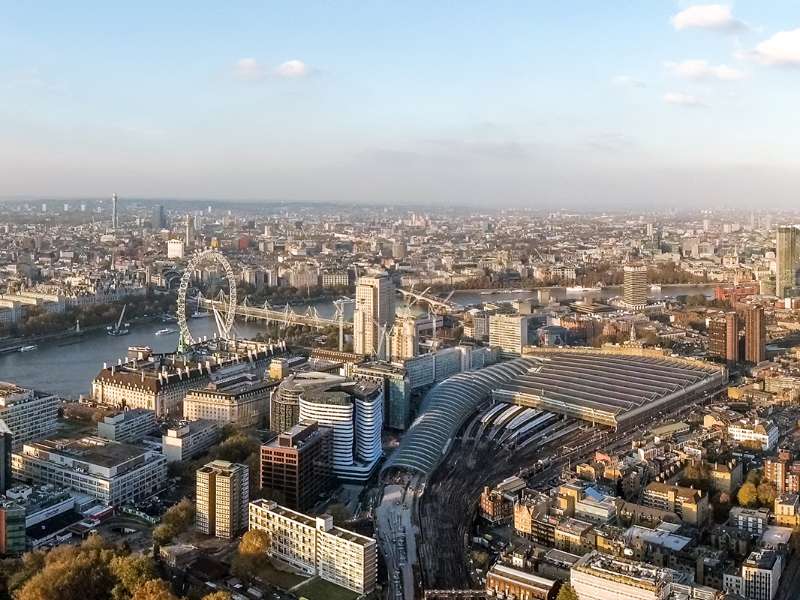
住所: Riverside Building, County Hall, Bishop's, London SE1 7PB
When the gigantic Great Wheel of London was built for the Empire of India Exhibition, later being used for the Imperial Austrian Exhibition as well, its 94 metres dwarfed any other building. When this behemoth was inaugurated at Earl’s Court on July 17, 1895, it was the largest ferris wheel on Earth, as well as London’s tallest structure. Besides its human passengers, the wheel was also a popular hangout for birds. In fact, in 1900, a cleaning person found a Goldcrest - the smallest bird in Great Britain - roosting inside one of the Wheel’s cars. The wheel was designed by Walter Basset, who was inspired by the 1893 ferris wheel of Chicago, which ran on steam and had forty cars to carry as many people and was considered an engineering marvel at the time. But by the end of the century, the curiosity regarding the wheel faded and it became a silent mostly-unused fixture. It was demolished in 1907 after having carried around 2.5 million passengers during its career. But its end came when, thanks to a malfunction, 74 people were left trapped for four-and-a-half hours. Its steel was sent to South Wales, where it was converted into containers for mustard and cookies.
The National Gallery in London presents the first exhibition in the UK dedicated to the 16th-century Flemish painter Catharina van Hemessen. The exhibition brings together many of the artist's surviving signed works, a rare figure in the history of European Renaissance art.
A research-based exhibition at the British Museum reassesses early Netherlandish drawing as a functional tool within artistic production rather than an autonomous work. Technical studies and revised attributions reveal a collective workshop practice and trace the gradual emergence of drawing as an independent medium.
A London exhibition traces Emilio Isgrò’s work across six decades, between visual poetry and conceptual art. Erasure emerges as a critical practice acting on language, knowledge and representation.
A Barbican retrospective surveys Robert Ryman’s work from the 1950s to the 2000s. Painting is presented as a material and perceptual experience based on subtle variation.

.jpg/jcr%3Acontent)