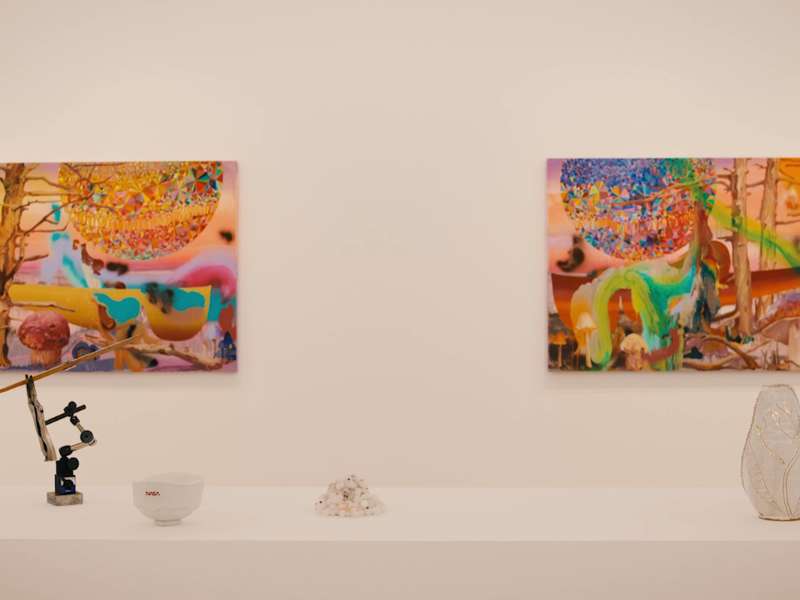
In 1926, the Tokyo Metropolitan Art Museum opened in Ueno Park, one of Tokyo’s main cultural centres, becoming Japan’s first public art museum. One hundred years later, Views of This Place - Ueno, Omuta, and Buenos Aires uses the anniversary to bring together three distant places and three different stories connected to the production and circulation of art. Running until 7 October 2026, the exhibition places the history of the institution alongside that of a self-taught painter who lived in Kyushu and the story of a painting that leads from Japan to Argentina. The first section is devoted to Ueno. Paintings, prints, photographs and archival documents trace a century of the museum’s activities and the transformations of the surrounding area. Since its foundation, the institution has played a particular role by providing artists with a space in which to exhibit their work, accompanying the development of modern and contemporary Japanese art. The second part moves more than a thousand kilometres from Tokyo to Omuta and Arao, mining towns in Kyushu where Shigeo Egami lived and worked for much of his exceptionally long life. Born in 1912 and died in 2014, Egami was a self-taught artist who depicted the landscapes around him using simple materials such as pencils, watercolours, pastels and crayons. Around 400 works reconstruct a practice that long remained outside the main art circuits and also include woodblock prints, abstract experiments and coloured paper works, some shown in Tokyo for the first time. The third section begins with a 1926 work, Garden Full of Zinnias, considered the first painting acquired by the museum. Research conducted by AHA! - Archive for Human Activities starts from the little-documented identity of its author, Kanetaro Fujioka, and intersects with the story of a man with a similar name, Tetsutaro Fujioka, who emigrated to Argentina in 1927. Settling in Buenos Aires, he worked in floriculture and garden design. Paintings, flowers, migration and family memory form a story that unfolds on the other side of the world from Ueno. The three sections therefore do not reconstruct a single history of Japanese art. They place the activity of a major institution alongside the work of an artist who remained in his own city and an individual story recovered through archival research. Three different perspectives on what took place, over the course of the same century, both inside and outside the museum.



.jpg/jcr%3Acontent)
-(1).jpg/jcr%3Acontent)