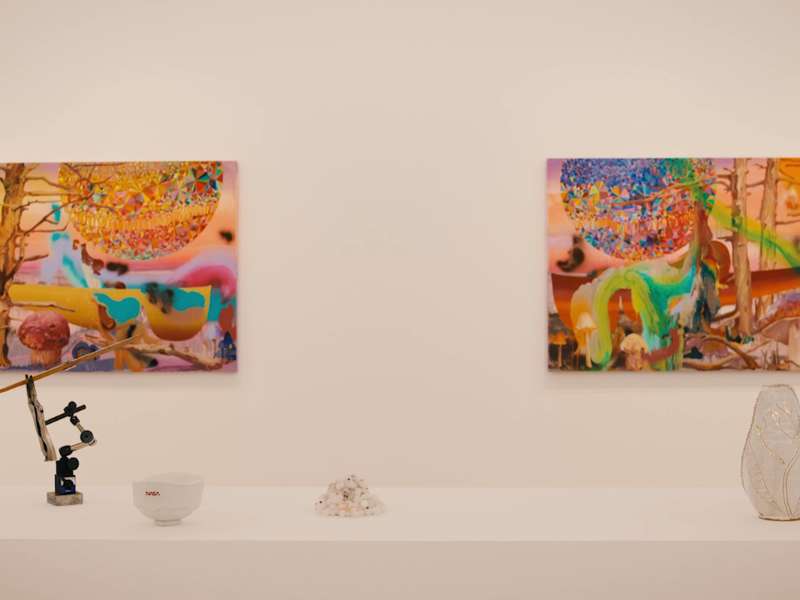
An exhibition at the Artizon Museum in Tokyo brings renewed attention to Shuzo Takiguchi, an unusual figure in twentieth-century Japanese culture. Poet, art critic, curator and artist, Takiguchi moved across different disciplines and played a decisive role in introducing European avant-garde movements to Japan, particularly Surrealism. The exhibition brings together around 130 works and archival materials that trace the full span of his activity. The starting point is poetry. From the late 1920s Takiguchi became deeply engaged with French Surrealism and developed an experimental form of writing that questioned the boundaries between word and image. Over the decades this exploration gradually expanded into the field of visual art. In the 1960s Takiguchi began producing two- and three-dimensional works, transforming poetic gestures into graphic marks and sculptural forms. Drawings, collages and small sculptural objects became extensions of a practice that originated in writing but unfolded within the visual space. The exhibition does not present Takiguchi’s work in isolation. Instead, it highlights the network of relationships he built throughout his life between Europe and Japan. Alongside his works appear those of artists who shared his cultural universe, including Paul Klee, Joan Miró and Joseph Cornell, as well as figures from the Japanese art scene such as Fukushima Hideko, Yamaguchi Katsuhiro and Kusama Yayoi. This constellation of works evokes the intellectual climate in which his ideas developed. The result is a portrait of a figure who has often remained on the margins of mainstream art history. Takiguchi was not only an author but also a cultural mediator. Through his writings, exhibitions and international connections he helped build a bridge between European avant-garde movements and the Japanese art scene of the postwar period.
The New National Theatre Tokyo presents a new production of Richard Strauss’s Elektra. The opera condenses a tragedy of obsession and violence into a single, intense act, driven by an extreme orchestral language. The performance is sung in German with surtitles and supported by audience-focused services.
The National Museum of Art in Tokyo presents an exhibition devoted to Eric Carle, a key figure in twentieth-century picture books. The show traces his career through original works and working materials. The exhibition highlights the picture book as an autonomous artistic practice.









.jpg/jcr%3Acontent)
-(1).jpg/jcr%3Acontent)