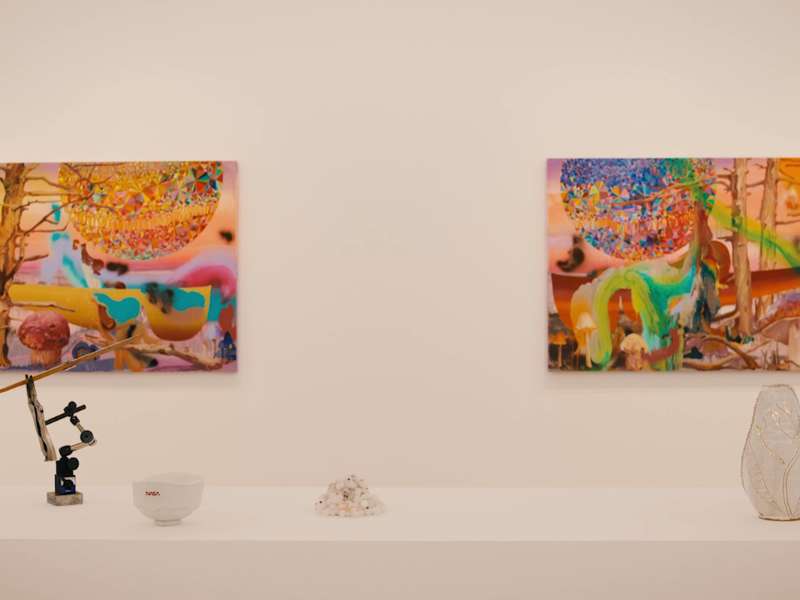
For Katayama Mari, the body is never a limit, but rather the starting point for rethinking how we look at the world. Born in 1987, one of the most recognized artists on the Japanese contemporary scene, her research interweaves photography, embroidery, sculpture, and installation to question the conventions through which society defines normality, identity, and beauty. Her practice often draws on her own personal experience, but avoids any religious dimension: the body becomes a tool for interrogating universal themes such as fragility, freedom, and the relationship between nature and artifice. The Mori Art Museum in Tokyo is dedicating her first solo exhibition as the winner of the Mori Art Award, the new biennial recognition established by the Mori Contemporary Art Foundation to support artists who are helping to redefine the landscape of Japanese contemporary art. The prize, awarded by an international jury, not only recognizes a lifetime achievement but also identifies figures destined to play a growing role on the global stage. At the heart of the exhibition is tree of life, the series of works begun in 2024 and already included in the collections of the Victoria and Albert Museum in London. More than a simple photographic series, it is an installation in which images, hand-sewn objects, and the exhibition space create an immersive environment. The photography, rigorously analog and hand-printed, dialogues with textiles and artifacts created by the artist, blurring the boundaries between image and sculpture, between document and symbolic construction. Embroidery and sewing do not simply represent a revival of artisanal techniques, but become the language through which Katayama redefines the body. Prosthetics, fabrics, sewn objects, and self-portraits coexist in the same work, suggesting that identity is never something fixed, but rather a continuous construction made of relationships, experiences, and transformations. Each work seems to expand the body beyond its anatomical boundaries, making it the meeting point between the individual dimension and social structures. This reflection runs throughout her career. In 2011, Katayama launched the High Heel Project, wearing high-heeled shoes designed specifically for her prosthetics as a gesture of affirmation of freedom of choice. At the same time, she has developed a practice that encompasses performance, music, fashion, and public interventions, confirming an artistic practice that rejects any disciplinary classification. For this reason, her works have been presented at the Venice Biennale, the Tate Modern, the Maison Européenne de la Photographie in Paris, and, more recently, the Victoria and Albert Museum.
Veronica Azzari - © 2026 ARTE.it for Bvlgari Hotel Tokyo




.jpg/jcr%3Acontent)
-(1).jpg/jcr%3Acontent)