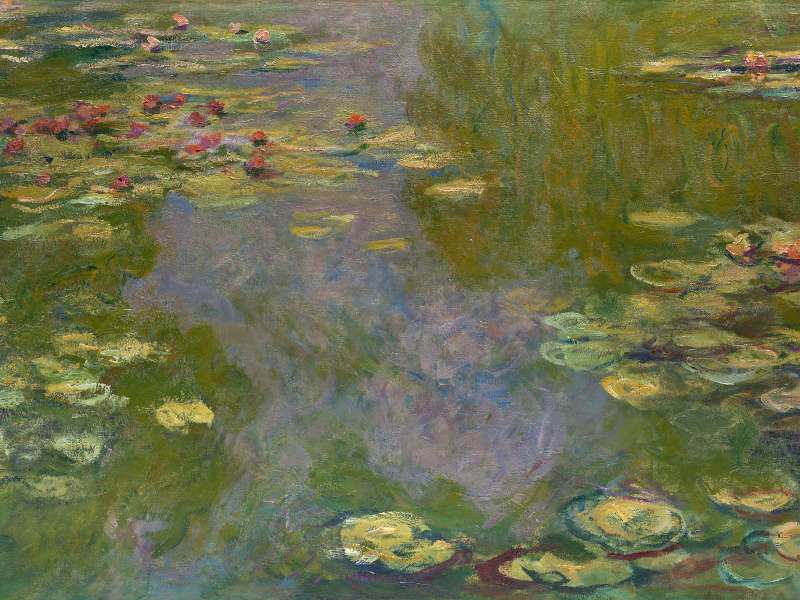
In 2026, one hundred years after the death of Claude Monet, the Musée de l’Orangerie presents an exhibition that revisits his work through a structural element of his practice: time. Not as an abstract theme, but as a working method built on repetition, variation and sustained observation of the same subject. Claude Monet, born in Paris in 1840 and died in Giverny in December 1926, was the founder of Impressionism and a central figure in the development of modern painting. His work is rooted en plein air practice and focused on the perception of light and its transformations. By the 1870s, his name had become associated with a new way of painting based on capturing immediate visual impressions. The exhibition follows this trajectory. The series of the 1890s, devoted to cathedrals, haystacks and poplars, introduce a method based on returning to the same subject under changing conditions. What matters is not variation in motif, but variation in light and atmosphere. Painting becomes a sequence. The final section focuses on the large Water Lilies compositions produced in the last decades of his life. Here, the serial principle shifts: fragmentation gives way to continuity, space expands and the reference to the subject gradually dissolves. The Orangerie, which houses the large-scale Water Lilies installations conceived by the artist, provides a natural context for this reading. The exhibition does not aim to present new discoveries, but to propose a shift in perspective: to consider Monet not through individual paintings, but through the process that connects them. The 2026 anniversary offers an occasion to return to a practice that shaped the course of twentieth-century painting. Less a celebration than a reassessment of how Monet constructs the image over time.