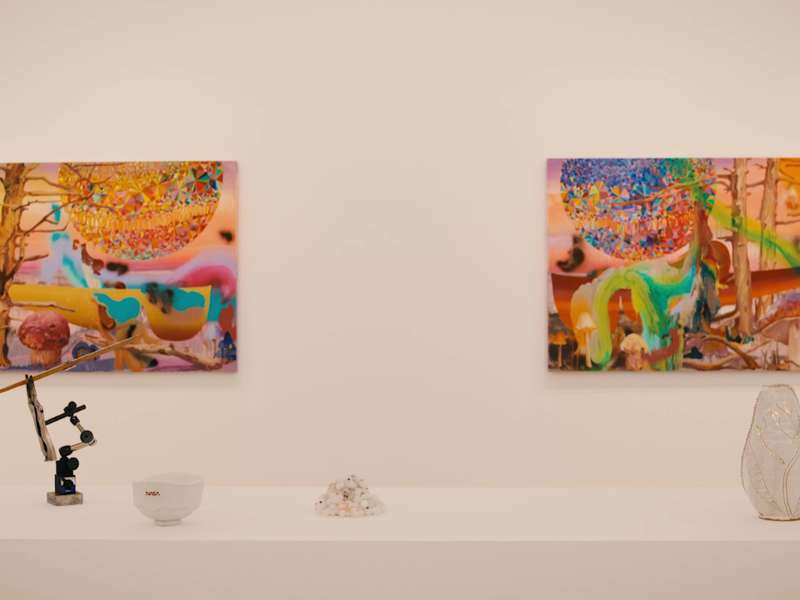
While the Mori Art Museum devotes a major retrospective to her, Mariko Mori is also the subject of a more intimate exhibition in Tokyo. From 3 November to 19 December 2026 the SCAI Piramide gallery, a short walk from Roppongi Hills, presents Unity, devoted to the series of works through which the Japanese artist attempts to give form to light, a constant source of inspiration in her work. Born in Tokyo in 1967, Mori rose to international prominence in the 1990s with photographs and videos in which she cast herself as a futuristic figure, among cyborgs, goddesses and manga-like characters, to reflect on gender identity, technology and pop culture. In 1997 she received an honourable mention at the Venice Biennale. Her practice later shifted towards the spiritual dimension, centred on the connection between human beings, nature, life and the cosmos. Today she lives and works between New York, Tokyo and the island of Miyakojima, in Okinawa, where she has set up her studio. On the gallery walls are the Unity works, circular "photopaintings" born of extensive research ranging from visits to archaeological sites in Japan and around the world to the latest findings in astrophysics. The artist seeks a light that does not come from outside but illuminates things from within, connecting them to one another. On the surface, made subtly glittering by three-dimensional computer graphics effects, the physical world is overlaid with an undefined realm. Mori herself refers to an image from esoteric Buddhism, the triangle at the centre of the Womb Realm Mandala that symbolises the wisdom of the cosmic Buddha Dainichi: in the same way, through abstraction, she tries to make visible the relationship between what we see and what escapes our gaze. Preparatory drawings are shown in the second room. In one corner stands Wave UFO Model II (2017), a model of one of her best-known works. Wave UFO (1999-2002) is a large drop-shaped dome, inspired by magatama, ancient Japanese jewels, in which the brain waves of three visitors are translated in real time into projected images. The original installation is being shown for the first time in Japan at the Mori Art Museum, in the retrospective All That Shines, on view until 28 March 2027. The dialogue between the two venues is deliberate: the gallery shows the original of Unity IX, which also appears in the new video All That Shines (2026) presented at the museum. An opportunity to follow the artist's journey from past to present, at a time when interest in spirituality increasingly runs through contemporary art.