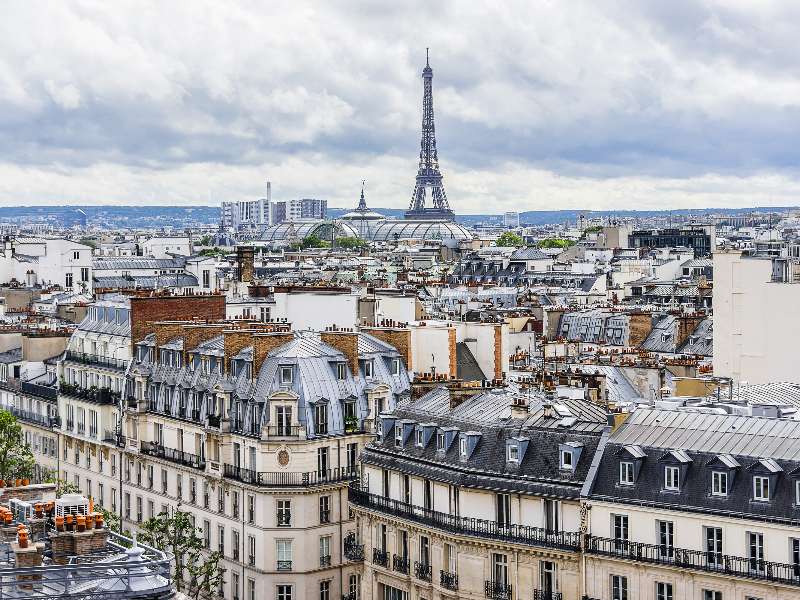
The Musée d’Art Moderne de Paris is presenting a major retrospective devoted to Brion Gysin, the British-born artist who lived from 1916 to 1986 and whose work resists easy classification within the history of twentieth-century art. Painter, poet, performer, photographer and musician, Gysin moved across many of the century’s avant-garde movements, working between literature, visual art and sound experimentation. The exhibition, titled The Last Museum, retraces the full arc of his career through more than 140 works. Gysin’s name is most closely associated with the invention of the cut-up, a technique developed in Paris at the end of the 1950s that consists of cutting up a text and rearranging the fragments at random to produce new linguistic combinations. The method, which partly revives earlier Dada practices, was developed together with the writer William Burroughs and became one of the most influential experimental devices in late twentieth-century culture. The exhibition follows the main stages of a career that often unfolded on the margins of traditional artistic institutions. Drawn to alternative and underground environments, Gysin travelled widely across Europe, North Africa and the United States, forming connections with an international network of artists, musicians and writers. This continuous geographic and cultural movement is reflected in the variety of languages he employed, from painting to sound poetry, experimental film and performance. A central section of the exhibition is devoted to the Dreamachine, one of the most unusual devices conceived by the artist. It consists of a rotating cylinder with slits and a lightbulb placed inside it. When the cylinder turns, the light passing through the openings produces a rhythmic flicker which, when observed with closed eyes, generates visions and mental images for the viewer. More than a sculpture or an installation, the Dreamachine is a perceptual experience designed to act directly on the brain. The exhibition also highlights Gysin’s connections with a number of key figures of the international artistic and literary scene. Alongside his works appear pieces by artists and writers with whom he maintained creative relationships or whom he influenced, including William Burroughs, John Giorno, Keith Haring and Patti Smith. Paris occupies a central place in the artist’s biography. Gysin stayed there during the 1930s while studying at the Sorbonne and returned in the early 1960s, frequenting surrealist circles and the famous Beat Hotel on rue Gît-le-Cœur, a meeting place for the European Beat Generation. From the 1970s onward he settled permanently in the French capital, living in an apartment opposite the Centre Pompidou and, shortly before his death, leaving his entire estate to the city of Paris.